

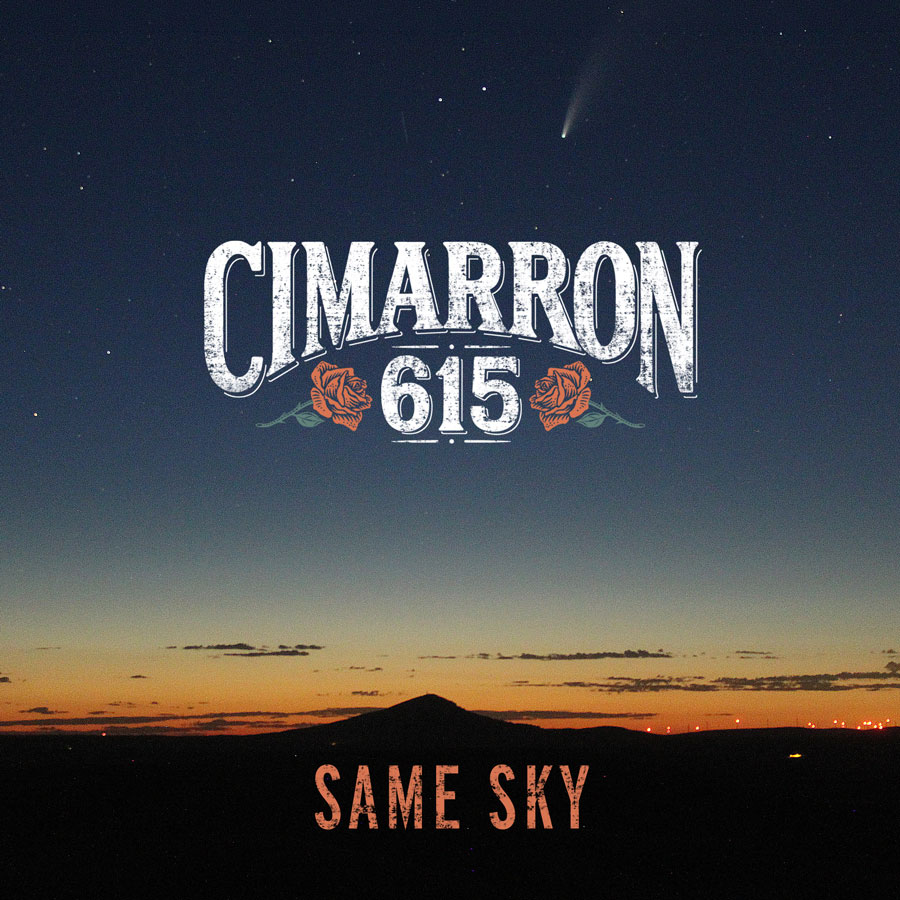


Same Sky
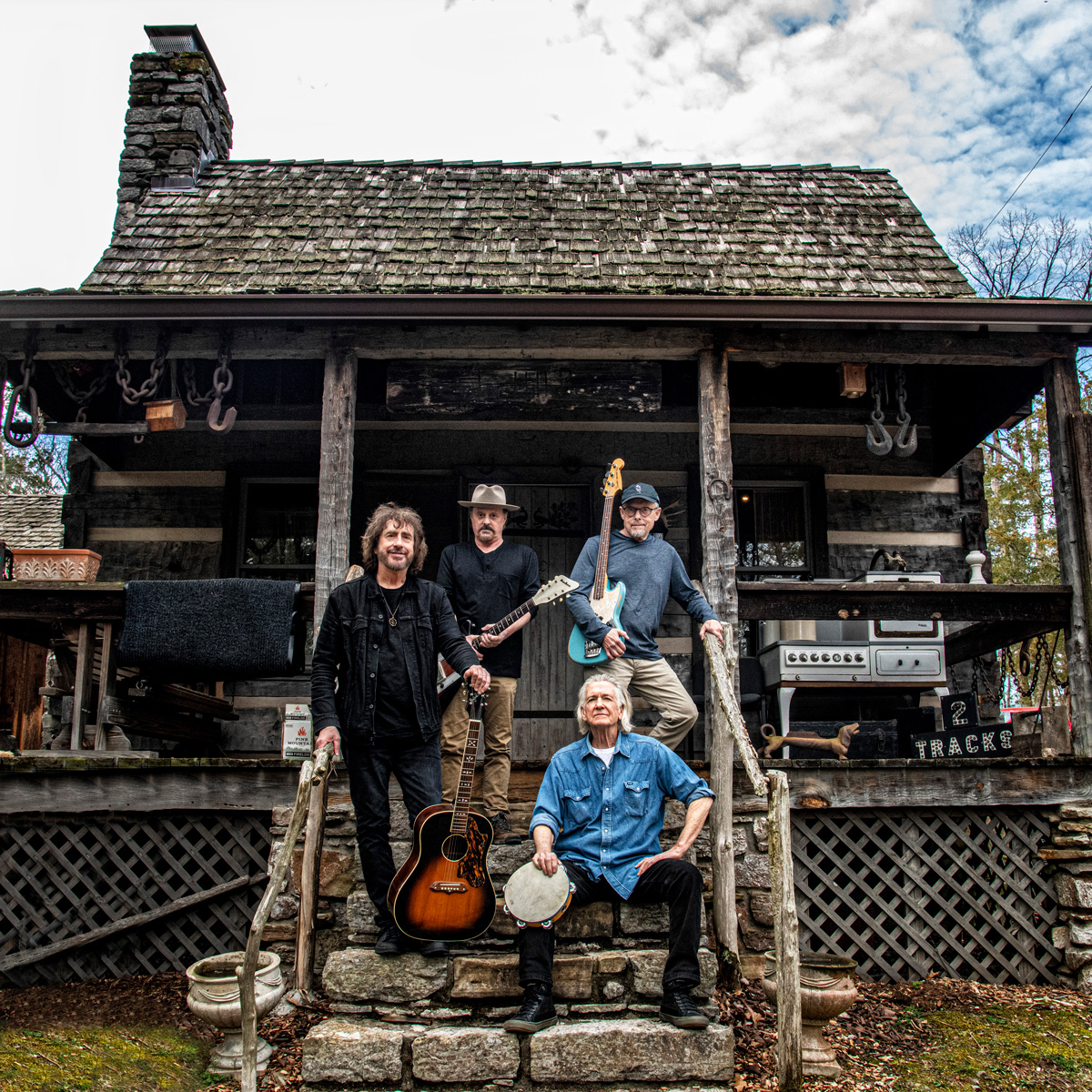
Ronnie Guilbeau: electric & acoustic rhythm & lead guitars, vocals
Michael Webb: Hammond B-3 & Farfisa organs, piano, electric & acoustic guitars, harmonica, mandolin, accordion, bass, vocals
Rick Lonow: drums, percussion, vocals
Jack Sundrud: bass, vocals
“One day you wake up/With your hands on the wheel” “Your Turn Now”
For Same Sky, their third Blue Élan Records album, the veteran, Nashville-based musicians who formed Cimarron 615 three years ago after the death of their Poco bandmate Rusty Young, have fully come into their own. The living, breathing definition of Americana, the group – named after the 1976 Poco hit, “Rose of Cimarron” and their home city’s area code – is equally steeped in any number of roots genres. That approach can be heard on their first two releases, Brand New Distance (2023) and last year’s self-titled sophomore effort, both showcasing their expert ensemble playing and patented lush, three- and four-part harmonies.
Produced by the band and recorded at Treasure Island Recorders in Nashville with engineer Brandon Epps, Same Sky offers a a wide variety of musical styles, from revved-up country twang (Guilbeau and Jon McElroy’s “Praying to Saint Rita”) to bluesy rock riffs (Sundrud and Craig Bickhardt’s apocalyptic “World Slidin’ Down”) along with everything in between.
There are forays into spirited bluegrass (native son Webb’s “Kentucky Callin’”), soulful Memphis R&B (Sundrud’s Al Green-flavored “The Intention of Your Touch”), breezy horn-driven reggae-ska (Sundrud and Charles Frank Glass’ “Aruba”) and even a spicy crawfish cajun zydeco stomp (a cover of “River Road,” written by Ronnie’s dad, fiddler “Gib” Guilbeau, with whom he played in the Burrito Brothers).
Speaking on the album title’s significance, Sundrud explained, “For me, it like we’re all one in this world, we’re all under the Same Sky.”
Other Same Sky highlights include “Broken and Blue,” a sprawling love ballad in waltz time and Tim Krekel’s “California,” an epic suite that struts their jam band bona fides as both an answer song to “Hotel California” and a nod to “Surf’s Up,” with “a bit of the Grateful Dead thrown in” for good measure.
“Our records have all been so eclectic because of our varied backgrounds,” said Sundrud, who would frequently perform and test out new material with Webb and Lonow at local Nashville clubs when Poco was off the road. “Americana as a brand seems to fit our style of music really well. The label just encouraged us to be ourselves, and it worked out.”
“We don’t try to fit into any niche,” said Guilbeau, who joined the band for their last album. “We all brought songs to the table, and everyone’s influences came out. It’s all there. I’m probably the most country guy in the band because I grew up with my dad’s music.”
“Jack, Rick and I were already really comfortable playing with one another when Ronnie came in,” added Webb, dubbing that group Open Road, with Rusty often sitting in as well before he passed.
With all four members writing, contributing lead and background vocals and playing their respective instruments, Cimarron 615 is truly a band for all seasons. Formed at the encouragement of label head Kirk Pasich after Young died in 2021, the lineup includes long-time Poco rhythm section members Sundrud (since the mid-‘80s) and Lonow (who came aboard in 2016). Multi-instrumentalist Webb entered the Poco fold in 2010, while Guilbeau, never an actual member, co-wrote the band’s classic 1989 hit, “Call it Love,” with Lonow. Webb and Sundrud co-produced Poco’s All Fired Up album in 2013 with Rusty Young, while Lonow, Webb and Sundrud all played on Young’s 2017 solo album, Waitin’ for the Sun.
“Your Turn Now,” co-written by all four, opens the album with a “Take It Easy” vibe that acknowledges the one-time sidemen are now in the driver’s seat, ready to take control of their musical destiny by accepting the torch from those who came before and preparing to pass it on to all who follow.
“That captures all of us, everyone putting their voices in together,” agreed Lonow about the group effort.
Webb’s “Comet in the Sky” offers an elegy for their late Poco bandmate Young, with an evocative pedal steel solo by Mike Daly. “There’s a shadow on my door/I know it can’t be you no more,” sings Michael plaintively.
“This is an acknowledgement of those who came before, who are no longer with us, particularly Rusty,” added Webb. “It’s saying, we’re going to miss you.”
Guilbeau said of focus track “Praying to Saint Rita”: “Songs have a funny way of writing themselves. I wrote that with my friend Jon McElroy. It has that kind of driving eighth-note thing. The idea came from watching the Dodgers post-season last year, and my wife praying to a saint for athletes, and it wasn’t working. We then discovered Saint Rita, the saint of hopeless causes. And it worked. I always kept the idea in the back of my mind to use in a song.”
Sundrud’s spirited “Aruba” — about spending a “lost weekend” on a sunny tropical paradise without ever leaving your room — offers a rollicking ska/reggae beat and horn-driven rhythms with the refrain, “Warm beer in the bathtub/Pot smoke in my scuba.”
“The arrangement and instrumentation just seemed to flow from the premise,” said Jack. “It was just a lotta fun to write and perform. It’s a good party song.”
Webb’s heavy blues-rocking “Hard Way to Make a Living” is his version of a “Working Class Hero,” with a large dose of David Crosby’s “Almost Cut My Hair,” and a CSN&Y feel which gave Michael and Ronnie a chance to duel on guitars, alternating the former’s fuzzy power chords and the latter’s sharp-edged riffing.
“That was the first song we came up with for the new album,” said Webb. “I feel it has a real Neil Young attitude to it.”
Guilbeau and Lonow’s “Sunday Dress” invokes a priest hearing a confession from an attractive woman, pitting the spiritual against the sexual, an aural equivalent of ever-present temptation (“She shakes my faith/She tests my will/But the wall between us is stronger than steel”).
“Broken and Blue,” which Sundrud co-wrote with Craig Bickhardt and Allison Marie Mellon, is a spiritual love ballad, a letter from an emotional battlefield, while the final track, “World Slidin’ Down,” another co-write between Sundrud and Bickhardt, features Webb’s grinding ZZ Top guitars depicting an apocalyptic, “Helter Skelter” vision of a world gone mad, caught up in “the devil’s own playground.”
Preparing for a late-summer tour, Cimarron 615 remain road warriors into their golden years, four individual resumes that combine for a whole lot more than the sum of their considerable parts.
“At the end of the day, this is just fun to do,” insisted Lonow. “A friend of mine used to say, ‘Music isn’t what we do, it’s what we are.’ We can’t quit it. At this point it’s not about the money or being famous. As long as we have the opportunity to play this music, why not do it?
“It’s just great to see the people in the audience looking back at you, smiling,” added Guilbeau about playing live. “There’s no better feeling in the world than that. This is like a second lease on life for me. I was ready to call it quits, but I’m too busy enjoying myself.”
For the four members of Cimarron 615, it’s too late to stop now.